Scott Kinney, Vice President at Discovery Education, at a hearing regarding the Future of Learning: How Technology is Transforming Public Schools on June 16, 2009.
Wednesday, June 17, 2009
Hey, I know that guy!
Made some origami for his kids a few years back, actually... In any case, here he is speaking in front of the U.S. House of Representatives.

Tuesday, June 16, 2009
On Language
I'm one of those teachers who will respond to the word "mines" by asking "Gold or silver?" and the question "Can I go to the bathroom?" with "I don't know, can you?"
Yeah, you can say I'm a stickler about some things. It's genetic, I think. Just try ending a sentence with a preposition when my sister's around.
I'm critical about this because one of the things we teach in school (according to our curriculum, at least) is how to communicate well. People who speak "properly" are more likely to do well in interviews and score higher paying and/or better quality careers.
But it's not the only way people speak. I dare you to turn on a radio and count how many times the word "ain't" is used in one hour's worth of song lyrics. There, it's acceptable. In school, it's not.
It gets worse when you head online, where sentences like "LOL school is teh suxxorz I hav a gud job even wit low gradez." are easily understood and not criticized for grammar or spelling ... in some circles.
"In some circles" is apparently the key phrase here. In art we need to know our target audience, and we use our works, whether they're visual, auditory, or something else, to communicate something. I'm not likely to use Modernism to illustrate a children's story about a young boy's first week at school.
But online we have a wide variety of audiences with which we can participate, and the language norms can be incredibly different in each tab of our browser. Several people I follow on Plurk and Twitter are fans of some strangely talking cats, but you still won't see us posting things like "I can has Summer vacation!" or "Invisible budget" in our Professional Learning Networks.
So, if you remember how I started this post it's safe to say I'm not in favor of students handing in essays written in 1337 or LoLspeak, even though I'm capable of communicating in both. But I'm not so quick to dismiss these offshoots of the English language. They were created by a generation that found themselves understanding the new technology far better than most of their teachers, so they built their own rules around it.
And if you look at it that way, it kinda roxxorz.
Yeah, you can say I'm a stickler about some things. It's genetic, I think. Just try ending a sentence with a preposition when my sister's around.
I'm critical about this because one of the things we teach in school (according to our curriculum, at least) is how to communicate well. People who speak "properly" are more likely to do well in interviews and score higher paying and/or better quality careers.
But it's not the only way people speak. I dare you to turn on a radio and count how many times the word "ain't" is used in one hour's worth of song lyrics. There, it's acceptable. In school, it's not.
It gets worse when you head online, where sentences like "LOL school is teh suxxorz I hav a gud job even wit low gradez." are easily understood and not criticized for grammar or spelling ... in some circles.
"In some circles" is apparently the key phrase here. In art we need to know our target audience, and we use our works, whether they're visual, auditory, or something else, to communicate something. I'm not likely to use Modernism to illustrate a children's story about a young boy's first week at school.
But online we have a wide variety of audiences with which we can participate, and the language norms can be incredibly different in each tab of our browser. Several people I follow on Plurk and Twitter are fans of some strangely talking cats, but you still won't see us posting things like "I can has Summer vacation!" or "Invisible budget" in our Professional Learning Networks.
So, if you remember how I started this post it's safe to say I'm not in favor of students handing in essays written in 1337 or LoLspeak, even though I'm capable of communicating in both. But I'm not so quick to dismiss these offshoots of the English language. They were created by a generation that found themselves understanding the new technology far better than most of their teachers, so they built their own rules around it.
And if you look at it that way, it kinda roxxorz.
Tuesday, June 02, 2009
Monday, June 01, 2009
On Employment.
So, I might not have the same job next year. (Link opens PDF.)
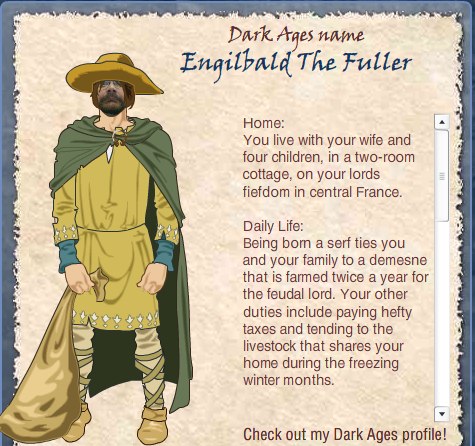
Whether or not it happens, I have been thinking a bit about my little corner of the internet and its effects on my chances of getting hired. I know some bloggers use assumed names so they just don't ave to worry about that. Too late for me, since last I checked googling the quite common name of "Aaron Smith" got me this result.
It is my hope, my dream, that schools with the right idea about both the arts and technology will see my ramblings here and think I am someone worth keeping in their employ.
I am also hopeful (though slightly less so) that the opposite is true - that schools with the wrong attitude towards the arts and technology will look upon my works and despair (sorry, couldn't resist the literary reference) write me off as someone they wouldn't want. But then, somehow I doubt those kinds of schools would bother looking at my website in the first place.
But mostly, I'm hoping that I don't have to look for a job in the first place. It is a big scary world out there and I've yet to recieve my renewed teaching certificate (completed the last requirement in December) in the mail. I know I was thinking of changing careers, but for some reason now does not seem the time for risk taking.
Whether or not it happens, I have been thinking a bit about my little corner of the internet and its effects on my chances of getting hired. I know some bloggers use assumed names so they just don't ave to worry about that. Too late for me, since last I checked googling the quite common name of "Aaron Smith" got me this result.
It is my hope, my dream, that schools with the right idea about both the arts and technology will see my ramblings here and think I am someone worth keeping in their employ.
I am also hopeful (though slightly less so) that the opposite is true - that schools with the wrong attitude towards the arts and technology will look upon my works and despair (sorry, couldn't resist the literary reference) write me off as someone they wouldn't want. But then, somehow I doubt those kinds of schools would bother looking at my website in the first place.
But mostly, I'm hoping that I don't have to look for a job in the first place. It is a big scary world out there and I've yet to recieve my renewed teaching certificate (completed the last requirement in December) in the mail. I know I was thinking of changing careers, but for some reason now does not seem the time for risk taking.
Thursday, April 30, 2009
Tumblr Tumbles
So the other day I was saying to myself...
"Self, you don't have enough accounts on web 2.0 type websites. You should go find another."
So I went and started a Tumblr page.
"Self, you don't have enough accounts on web 2.0 type websites. You should go find another."
So I went and started a Tumblr page.
OK, that's not true.
The real reason was because on a semi-recent (actually kinda old ... I'm a little behind) episode of Net @ Nite it was mentioned that Tumblr allowed you to use your phone to call in audio that would be posted directly to your Tumblr page.
Sound familiar? Yeah, it's what Gcast lets you do, only unlike Gcast they haven't started charging for that feature yet.
Well ... I was underimpressed, to say the least.
There was no option to hear your recording before posting it live to the internet. I'm someone who usually needs at least one do-over when it comes to recording anything, and I see how this could go very, very wrong.
Also, I know phone calls are by default low quality audio, but I think they may have compressed the file even beyond that. I assume this was in the name of conserving as much bandwidth as possible, and considering Tumblr's popularity I understand that could be a big issue.
Unfortunately, the final nail in the coffin was that the resulting RSS feed didn't have an enclosure. That's geek-speak for "It may be audio on the web, but iTunes will never let it be a podcast." Except for certain thinking-outside-the-box uses, this is not a Gcast replacement.
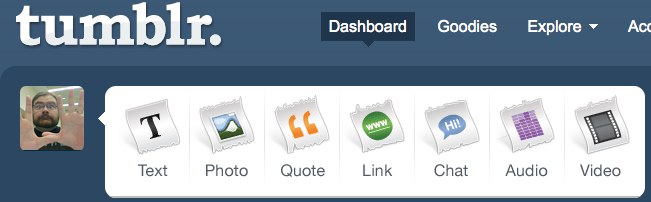
The rest of Tumblr was a collection of ups and downs. The service is a miniblog, as it allows more than microblogs like Twitter but it's not nearly as full-featured as WordPress. They have multiple posting methods, whether from their web interface dashboard (seen above) a variety of apps via their API, or their bookmarklet, which I have to say is one of the slickest (and ironically, feature rich) ones I've seen so far. Still, nothing they had really jumped out at me as being better than the other services I was already using.
And then I decided to search through the Tumblr community to see what I could find in the way of educators, and I discovered that I'm not likely to recommend this service any time soon. At least, not until they include a Google-like safe search feature. I found too much that I would be embarrassed to have to explain if a student showed it to me in class, and that was while looking for teachers!
My final take? If all of your friends are using Tumblr go ahead and make an account. If you want a free blog? There's plenty that are better. Want a microblog PLN? Go with Plurk or Twitter. Picture posting? Flickr. Cool links? Del.icio.us or Diigo.
But don't bother with Tumblr, it really doesn't seem to be worth it yet.
Wednesday, April 22, 2009
10 Ways To Be A Better Presenter
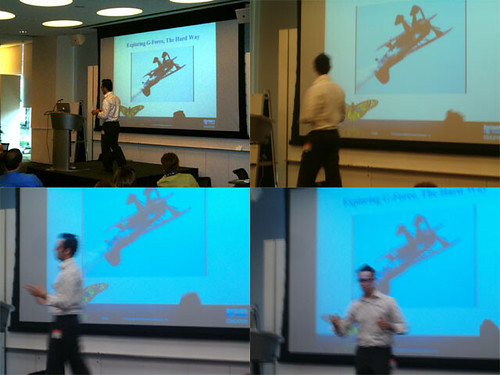
Having survived my 4th consecutive year presenting at MICCA & a few other places, I think it's safe for me to say I know one or two things about it. At least, I've yet to have a session that ended emptier than when it started, so I've got that going for me.
So here's a list of 10 things that, if done correctly, will help your audience stay engaged and secure in the fact that you know what you're talking about. (Or at the very least, they'll help you fake it.)
They're numbered, but the order could be changed. I'm not giving much thought to that part.
10. Market yourself. Don't spend too much time on this, but your audience should know why you're worth listening to on this subject. Are you a DEN Star? Google Certified? Do you have 20 years experience working with Web 2.0 technology? (OK, maybe in dog years...) Spend 30 seconds telling them why you're special. Letting them know how to contact you if they have more questions later is good, too.
9. Don't sit down. Some people can get away with it, but most of us can't. An enthusiastic presenter is more likely to capture an audience, and you can show your enthusiasm better while up and moving.
8. Podiums are walls. Even if they aren't the big, bulky, "This could stop a truck and still be usable" podiums, they create a barrier between you and your audience. Don't hide behind one unless you audience scares you. (In fact, don't use one then, either. Audiences can smell fear.)
7. PowerPoint is there to back you up. Not the other way around. Substitute "PowerPoint" for "Keynote," "Prezi," "Google Presentation," or whatever you intend to use. If all you're doing is reading your slides, you're wasting space, time, and potentially oxygen.
6. Limit yourself. Just because a product or service can do 53,781 different things does not mean you have to cover all of them. Tying in with #7: Just because PowerPoint has a plethora of transitions does not mean you should try to use all of them in a single session. "Random" is the worst possible transition choice ever. In both cases, you should pick your favorites and stick with those.
5. Ask questions. Your audience is full of intelligent people. (Granted they're listening to you, but there's no reason to let them know that's a strike against them!) The questions you ask could be ones that just check to see if they're paying attention or ones that change the course of your discussion topic, but they should have some way of knowing that you're acknowledging their presence.
4. Don't print your PowerPoint. I'm not just saying that because as I type this it's Earth Day. I'm saying this because paper is made of matter. The science geeks out there (including me) will be happy to tell you that means it has mass and volume, and that means 2 reasons why your audience will resent your 10 page printout once it's added to all the other printouts they've collected at that conference. It adds up and shoulder pain is serious business. Do them and yourself a favor and make a wiki with all the useful information on it. Share the link at the beginning and end of your presentation and everyone will be happier for it.
3. Don't admit mistakes that don't mater, but admit the ones that do. So you wanted to cover 21 different Web 2.0 sites and skipped #17? Forget about it. If you have a wiki (you read #5, right?) they'll be able to find ay small points you missed on there. But remember that with the exception of my 2nd grade teacher, we're all human. Breathe deep, correct it if you can, acknowledge it if you can't, and move on. Your audience will respect you more or it, trust me.
2. Have a backup. PowerPoint will crash. The network will go down. Something will go horribly wrong if you don't have a plan B. When I'm talking about websites I'll usually have screen captures of all the features I want to showcase, just in case. I learned this lesson the hard way. I will not share that story.
1. Your presentation will never be finished. I've seen keynote speakers changing slides shortly before they presented. I myself have redone a presentation several times, then scrapped the whole thing to start over again because I wasn't satisfied. Leonardo da Vinci reportedly said "Art is never finished, only abandoned." That you want to keep making it better is admirable, but don't stress out that you're not "done."
MICCA09 Sessions 3 & 4
 As I was presenting these myself, I wasn't actually taking the time to give a play-by-play in Plurk. You can see my wikis for Session 3 and Session 4 if you want my take on them, though.
Another option would be to check out Selena Ward's Plurk log of my Session 3 and someone else's Session 4 (She didn't attend mine because she's already a PLN master). Good stuff, there.
Subscribe to:
Posts (Atom)